


Head masters!
- steve8125
- Sep 2, 2025
- 3 min read
In recent years, the printing industry has experienced remarkable changes, with inkjet technology in the industrial space becoming a leader in numerous applications. As businesses seek faster, more efficient, and cost effective friendly printing solutions, advancements in inkjet technology and printhead design are opening the door to a new era of possibilities.
Inkjet printing has come a long way, evolving from basic desktop models to essential tools in industrial and graphical applications – expanding its reach into diverse sectors. It can now print on various materials including textiles, plastics, wood and metals, making it a versatile choice for manufacturers.
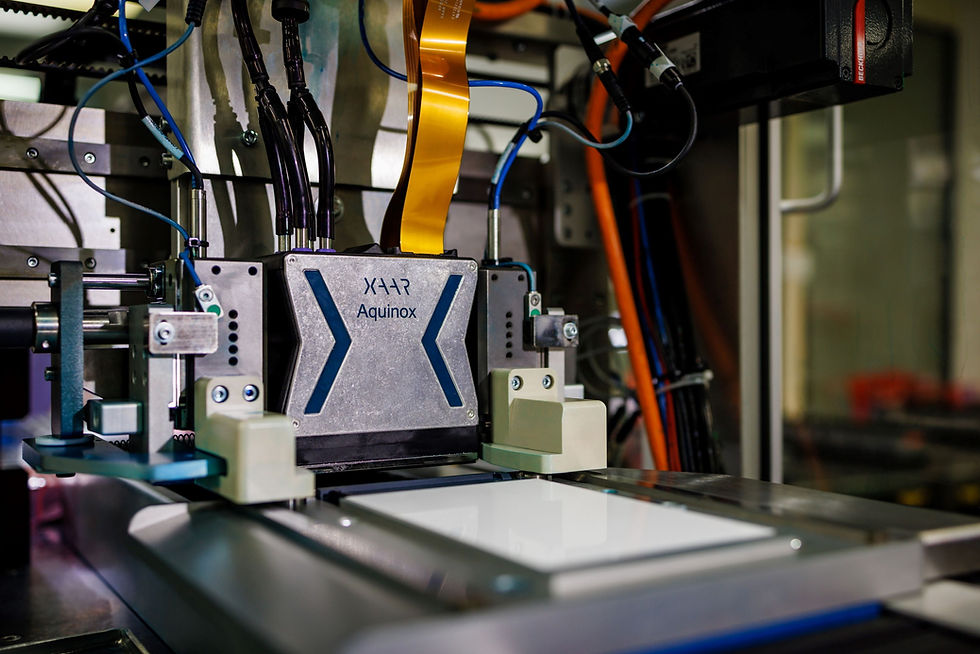
A driving force behind this evolution is the continuous improvement of printheads. Modern printheads deliver remarkable precision and speed, helping manufacturers in a wide range of sectors from automotive to aerospace, from construction to electronics, from textiles to signage, produce high quality prints quickly. Some advanced printheads offer drop sizes as small as 1 picolitre, providing incredible detail, colour and accuracy. Technologies like piezoelectric and thermal inkjet allow better control over droplet size and placement, further enhancing quality.
Recent advancements in printhead design are largely focused on enhancing performance, reliability, and ease of maintenance, as well as allowing the technology to print on even more materials, quickly and easily. One notable development is the use of MEMS (Micro-Electro-Mechanical Systems) technology in printhead manufacturing. MEMS enables the creation of smaller, more efficient printheads capable of producing finer droplets, leading to resolution improvements.
Additionally, manufacturers are now exploring new materials for the construction of the printheads themselves. For instance, ceramics and advanced polymers have shown promise in increasing durability and resistance to clogging – an issue that can affect print quality. The ability to print with a wider range of inks, including UV curable and solvent based inks, broadens the applications of inkjet technology across industries.
The role of software in advancing inkjet technology cannot be understated. Modern printing systems often feature sophisticated software that optimises print quality and speed. This software can analyse the printing environment, making real time adjustments to ensure consistent results.
Moreover, integrating artificial intelligence (AI) and machine learning into printing systems is changing the operational landscape. These technologies allow printers to learn from past jobs, predict potential issues, and automatically adjust settings for peak performance.
With growing environmental awareness, sustainability has become a central focus in inkjet technology development. Companies are increasingly seeking ways to lower their carbon footprint and reduce waste. Innovations in ink formulations, such as water based or biodegradable inks, are becoming popular as eco friendly alternatives to traditional solvent based inks.

Advancements in printhead technology also play a critical role in fostering sustainability. For instance, high resolution printheads can produce smaller droplets, allowing for more precise ink placement and reducing waste significantly.
Looking ahead, the future of inkjet technology in industrial printing is packed with possibilities. Several trends are expected to define the next generation of printheads and printing systems.
As businesses seek more personalised and customised offerings, the capability to make unique prints on the fly will be vital. Future inkjet systems may feature advanced customisation functions, allowing manufacturers to switch designs and colours seamlessly without lengthy downtimes.
Future printheads could include enhanced connectivity features for real time monitoring and data analysis.
Exploring new materials for inks and printheads will remain a priority. Innovations in nanotechnology and advanced polymers are anticipated to produce inks with better adhesion, durability, and vibrant colours.
Automation will play a crucial role in shaping the future of industrial printing. The integration of robotic systems and streamlined workflows will make the printing process more efficient. Future inkjet systems might be designed to work seamlessly with automated production lines, ultimately speeding up production while lowering labor costs.
Innovations in inkjet technology are transforming the industrial printing landscape, presenting new opportunities for efficiency. As we continue to witness advancements, the future of inkjet printing appears bright, promising a revolution in various industries, and extending the technology to more markets than ever before. By adapting to these innovations, manufacturers can remain competitive and meet the dynamic demands of the market.
The journey of inkjet technology is just beginning, and the possibilities for the future are limitless. With ongoing research and development, the next generation of inkjet printheads will undoubtedly expand the boundaries of industrial printing, leading to a more efficient and sustainable future.


Comments